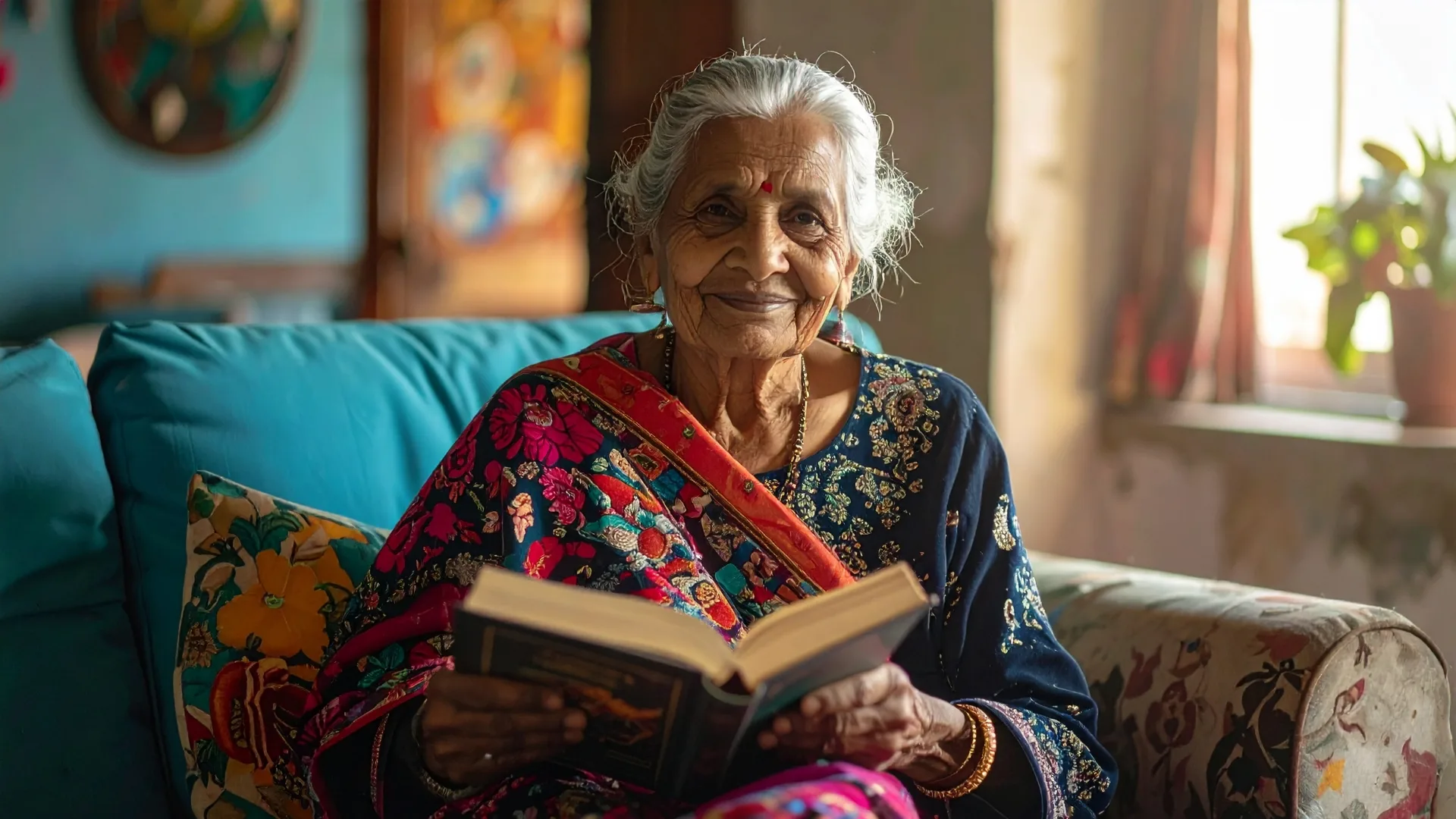
The book arrived on a Tuesday.
This is the kind of detail that should not matter and does.
Tuesday in the old-age home in Dadar was cleaning day. The floors were mopped with a phenyl solution that turned the air sharp and medicinal. The television in the common room played a devotional channel at a volume calibrated for the hearing aids of the majority, which meant it was too loud for everyone. The morning tea came at eight and the lunch bell was at twelve-thirty and in between there was a particular quality of time that Meera Iyer, who had been in the home for four years, had learned to navigate.
She was seventy-three years old. She had been a Sanskrit professor at a women's college in Pune for thirty-one years. She had a son in Toronto who called on Sundays and a daughter in Hyderabad who called on Wednesdays and neither of whom - and she understood this without bitterness - could accommodate her in their current lives in their current cities.
She read. She had always read. She was reading when the books arrived.
The Donation
Rohit Sharma was thirty-four, lived in a third-floor flat in Dadar West, and was in the middle of what his wife called 'the great declutter' - the ambitious weekend project of clearing a decade of accumulated books from the shelves that lined the study.
He had kept the ones he loved. He had kept the ones he thought he might love someday. He had kept a few he felt he should have loved and had not.
Everything else - approximately 200 books, sorted into four cardboard boxes - he had listed on CauseKind's In-Kind platform.
He had not thought very carefully about what was in the boxes. He had thought about the shelf space. He had specified 'assorted English novels and non-fiction - good condition' and uploaded a photograph of the boxes stacked neatly in the corridor.
The request came from the Shanti Niwas old-age home on the same day.
The home's activities coordinator - a young woman named Devika who was twenty-six and who ran an informal lending library for residents from a shelf beside the common room - had seen the listing and sent a request through the platform for whatever the donor was willing to give.
Rohit loaded the boxes into his car on Saturday morning and drove four kilometres to Shanti Niwas.
He spent twenty minutes there. Devika signed the delivery confirmation on the CauseKind platform. He drove home. By noon he was back to the declutter.
He had no idea that one of the 200 books was about to finish a conversation that had been suspended for forty years.
The Series
Meera Iyer had read the first two books of the trilogy in 1983.
She was thirty years old. She was a junior lecturer. She had read them during the summer break - the long, slow Pune summer of that year - sitting on the narrow balcony of the flat she shared with her husband, a glass of nimbu pani going warm beside her.
The books were by a British author she had found recommended in a literary magazine. They were dense, philosophical novels - part historical fiction, part meditation on memory and time and the impossibility of fully knowing another person. She had read the first one in three days and the second one in four and at the end of the second she had sat for a long time looking at the last page.
The story was not finished. It was clearly the middle of a longer work. A third book was coming, the author's note suggested, to complete the trilogy.
She had waited for the third book.
She had looked for it at the British Council Library in Pune the following year. She had asked at Manney's bookshop on Clover Centre. She had, in those pre-internet years, simply not found it - and gradually, as her life had filled with marking papers and raising children and the accumulating business of living, she had filed the unfinished story away in the part of the mind reserved for things that are not forgotten, exactly, but are not actively remembered.
For forty years, without thinking about it often or thinking about it consciously at all, she had not finished that story.
Tuesday
Devika had sorted the 200 books over two evenings.
She had organised them by genre and placed them on the common room shelf, on the small table outside the television room, on the windowsill of the reading corner where the morning light came in best.
She had given Meera Iyer first pick because Meera read faster than anyone else in the home and because she sensed - without knowing quite why - that Meera needed books in a way that went beyond passing the time.
Meera had come to the common room on Tuesday morning, on the day of the phenyl floors and the loud devotional channel, and she had looked at the books the way she always looked at new books - with the particular attention of a person who has spent a lifetime considering what words do to minds.
She had picked up several and read the first page.
She had put them down.
And then she had picked up a book near the end of the shelf - a paperback with a worn spine, slightly faded on the cover from what looked like years in sunlight - and she had read the title.
And she had stood very still.
It was the third book.
The third book of the trilogy she had been waiting for since 1983.
Published, she read on the copyright page, in 1991. Available, as it turned out, for thirty-five years. Found by her on a Tuesday morning in a common room in Dadar, donated by a man she would never meet from a flat four kilometres away, via a platform that had matched a box of assorted English novels with a lending library for elderly residents.
She sat down in the chair by the window.
She opened to the first page.
The morning tea came at eight. She did not drink it. The lunch bell rang at twelve-thirty. She was on page 140. A volunteer knocked on her door at two o'clock to check on her, which was protocol for residents who missed meals.
She told the volunteer she was fine. She was more than fine. She was in the middle of something that had been waiting forty years to be finished and she was not stopping now.
What She Read
The novel picked up exactly where the second had ended - the same characters, the same unresolved questions, the same dense, patient prose that she remembered from the balcony in Pune in 1983.
She had worried, faintly, that she would not remember enough of the first two books to follow the third. She had not re-read them - she did not have them anymore; they had been lost in one of the three house moves across her married life.
But the story came back as she read, the way things from a certain depth of the memory do - not as a recalled sequence of events but as a felt familiarity, a recognition, the sense of returning to a place rather than visiting it for the first time.
She read it over four days. The Tuesday of the phenyl floors, then Wednesday, then Thursday, then Friday morning - the last chapter finished before the eight o'clock tea, in the growing light of a November morning, the devotional channel not yet started, the home quiet around her.
She closed the book.
She held it in her lap for a long time.
The ending was not what she would have predicted in 1983, sitting on the balcony in Pune, making guesses about where the author was taking the story. It was better. It was the kind of ending that changes what came before it - that reframes the first two books entirely, so that the whole trilogy becomes, in retrospect, a different story from the one she had thought she was reading.
She sat with that for a while.
There is a particular emotion that has no single name in English - the emotion of finishing something long, of arriving at an ending that was deferred for so long it had stopped feeling possible. In Sanskrit, she knew, there were words for the subtle emotional states that English could not quite reach.
She thought of one now. She held it quietly. She did not need to say it to anyone.
She simply sat with the finished book in her lap, in the morning light, complete.
What Rohit Sharma Did Not Know
Rohit Sharma received his Impact Certificate on the Saturday after the donation.
It confirmed: 200 assorted books donated to Shanti Niwas Old-Age Home, Dadar. Delivery confirmed by the home's activities coordinator. 12 residents accessing the donated books as of date of confirmation.
He looked at it for a moment.
He felt good about the shelf space and slightly better about himself than he had expected to.
He shared the certificate to his LinkedIn with the caption: 'Small action, made easy by CauseKind. Cleared some shelf space and hopefully gave someone something good to read this week.'
He did not know about Meera Iyer.
He did not know about the balcony in Pune in 1983, or the British Council Library, or Manney's bookshop, or the forty years of an unfinished story.
He did not know that the paperback with the faded spine had sat in his study for eleven years - purchased at a secondhand bookshop in Bandra, read once, loved, placed on the shelf, forgotten - and had travelled four kilometres in a cardboard box to complete something he had never known was incomplete.
He did not need to know.
The giving did not require his awareness of what it had done.
It only required the book to make the journey.
There are 3.1 million registered NGOs in India. There are dozens of giving platforms, thousands of donation drives, millions of WhatsApp forwards asking for support.
And there are, in homes and flats and studies across every Indian city, books that someone loved and set aside. Books that meant something to their first reader and are sitting, waiting, complete, ready to mean something to the next one.
Meera Iyer finished a story she had been waiting forty years to finish.
Rohit Sharma cleared some shelf space.
Between those two facts, there is a four-kilometre drive and a ten-minute platform interaction and one of the most quietly perfect acts of in-kind giving that has ever taken place.
Your books are waiting to make someone's Tuesday.
Browse the lending library requests near you.
Donate Books to an Old-Age Home or Library Near You → List Your Books on CauseKind → Create Your Free Account →
CauseKind is India's verified giving platform. Zero fees. Admin-verified listings. Every donation matched within 10 km and tracked to delivery.