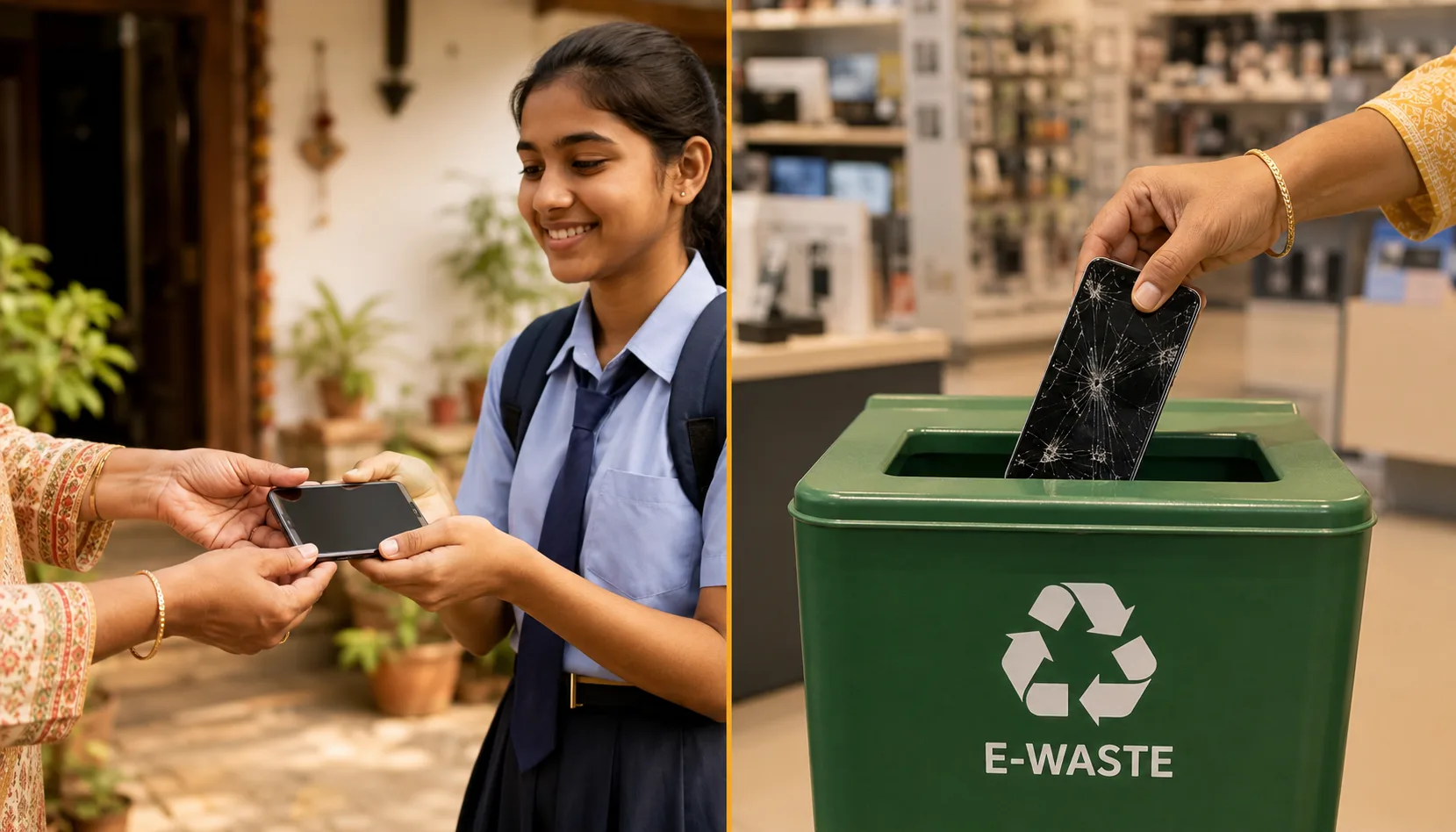
You have an old device.
It might still work. It might be partially functional. It might be completely dead.
Two responsible options exist: donate it so someone else can use it, or recycle it responsibly so its materials are recovered rather than becoming hazardous waste.
Choosing the right option depends on one straightforward question: does this device still work?
If yes - donate.
If no - recycle.
Here is why, and how to do each correctly.
When to Donate: The Working Device Decision Tree
A device should be donated - not recycled - when it meets these criteria:
- ✅ Powers on and completes startup
- ✅ Connects to Wi-Fi
- ✅ Battery holds charge for 3+ hours of active use
- ✅ Screen displays without major obstruction to visibility
- ✅ Basic functions (camera, speaker, microphone, ports) work
If your device meets all of these, it has remaining useful life. Recycling it removes that useful life permanently. For the 250 million Indian students without a digital learning device, your 'old' but functional device is a meaningful educational tool.
Donation through a verified platform like CauseKind ensures:
- The device reaches a specific verified student
- Delivery is confirmed and documented
- No functional useful life is wasted
- No carbon cost of recycling is incurred unnecessarily
The environmental and social calculus is clear: a working device donated to an education-focused recipient is more valuable than the same device recycled for material recovery.
When to Recycle: The Non-Functional Device Situation
When a device:
- ❌ Does not power on
- ❌ Has a completely shattered screen
- ❌ Cannot connect to any network
- ❌ Has severe water damage affecting core functions
- ❌ Is so old it cannot run any current educational app
- it is not donatable. Donating a non-functional device to an individual or NGO creates a disposal problem for them, not an educational solution.
The right choice for non-functional devices is responsible e-waste recycling.
In India, e-waste contains valuable materials - copper, gold, silver, palladium - as well as hazardous materials - lead, mercury, cadmium - that cause significant environmental and health damage when disposed of in general waste.
Responsible e-waste recycling recovers the valuable materials and safely neutralises the hazardous ones.
How to Recycle Electronics Responsibly in India
India has a regulated e-waste management system under the E-Waste (Management) Rules, 2022. Responsible disposal options include:
Manufacturer take-back programmes:
Most major electronics manufacturers in India - Samsung, Apple, Lenovo, HP, Dell - have producer responsibility schemes that accept old devices for responsible recycling. Check the manufacturer's India website for current take-back details.
Authorised e-waste recyclers:
India has hundreds of CPCB (Central Pollution Control Board) authorised e-waste recyclers. These are certified to handle e-waste safely and are the most responsible disposal option.
- Attero Recycling: attero.in (accepts devices nationwide)
- Karo Sambhav: karosambhav.com (producer responsibility network)
- E-Parisaraa: For Bangalore-based donors
Retailer collection programmes:
Many large electronics retailers - Croma, Reliance Digital - have e-waste collection points. Check in-store for current programmes.
What not to do with non-functional devices:
- Do not throw in general waste
- Do not give to unregistered scrap dealers who may not handle hazardous materials safely
- Do not donate to NGOs or individuals - this creates a disposal burden
The Grey Zone: Devices That Work But Barely
Some devices sit in a grey zone - they function, but marginally. Battery drains in 90 minutes. Screen has a crack that affects one corner. Wi-Fi connects but drops occasionally.
For these devices, consider whether a small repair investment is worthwhile:
- Battery replacement: ₹300 to ₹800 for most Android phones. Transforms a marginal device into a confidently donatable one.
- Screen repair: ₹800 to ₹3,000 depending on device. Worth it for devices with strong specifications otherwise.
- Wi-Fi chip repair: More complex - if Wi-Fi is fundamentally broken, recycling is likely the right choice unless repair cost is low.
A small repair investment that converts a marginal device into a fully functional educational tool is money extremely well spent relative to the impact produced.
The Environmental Case for Donation Over Recycling
Recycling is presented as the environmentally responsible choice for old electronics - and it is, for genuinely non-functional devices.
But for working devices, the environmental argument strongly favours donation:
Manufacturing a new device - the device the student would otherwise need to have manufactured - produces approximately 40 to 80 kg of CO2 equivalent in the production process, consumes rare earth materials, and generates production waste.
Donating a working device - extending its useful life by 3 to 5 years - avoids that entire manufacturing footprint.
The carbon avoided by donating one working laptop rather than recycling it is approximately equal to not driving 300 to 600 km in a petrol car.
Donation is the most environmentally responsible choice for working devices.
Frequently Asked Questions
Should I donate or recycle my old phone in India?
If your phone powers on, connects to Wi-Fi, and holds battery charge for 3+ hours, donate it through CauseKind to a verified student. If it is non-functional, recycle it through an authorised e-waste recycler. Never throw electronics in general waste.
Where can I recycle electronics responsibly in India?
Use CPCB-authorised e-waste recyclers such as Attero Recycling, Karo Sambhav, or manufacturer take-back programmes from Samsung, Apple, Lenovo, HP, and Dell. Large retailers like Croma and Reliance Digital also have e-waste collection points.
The decision is simpler than it seems.
Does it work? Donate it. A student nearby needs it.
Does it not work? Recycle it responsibly. The materials can still serve a purpose - just not as a device.
Neither option involves the bin. Both options are better than the drawer.
Donate Your Working Device Through CauseKind → Browse Student Device Requests Near You → Read: How to Donate Laptops and Electronics in India →
CauseKind is India's verified giving platform. Zero fees. Admin-verified listings. Every donation matched within 10 km and tracked to delivery.