When most people think of charity in India, they think of money.
A bank transfer. A UPI payment. A cheque to a registered NGO. Money, the thinking goes, is flexible - it can buy whatever is most needed, whenever it is needed.
This is true. But it is not the whole picture.
For a large and growing category of everyday community needs - school supplies, clothing, devices, hygiene products, household essentials - in-kind donation consistently outperforms cash giving on the metrics that matter most: speed, efficiency, impact transparency, and the dignity of the recipient.
Here are seven specific, evidence-backed reasons why.
Benefit 1 - Zero Administrative Overhead: Every Item Reaches Its Destination
When you donate cash to an NGO, a portion of that donation - typically 15% to 40% depending on the organisation - is absorbed by administrative costs before reaching the community: staff salaries, office rent, transport, programme management.
This overhead is legitimate. NGOs need operational capacity to function.
But it means that ₹1,000 donated as cash may result in ₹600 to ₹850 worth of goods or services reaching the beneficiary.
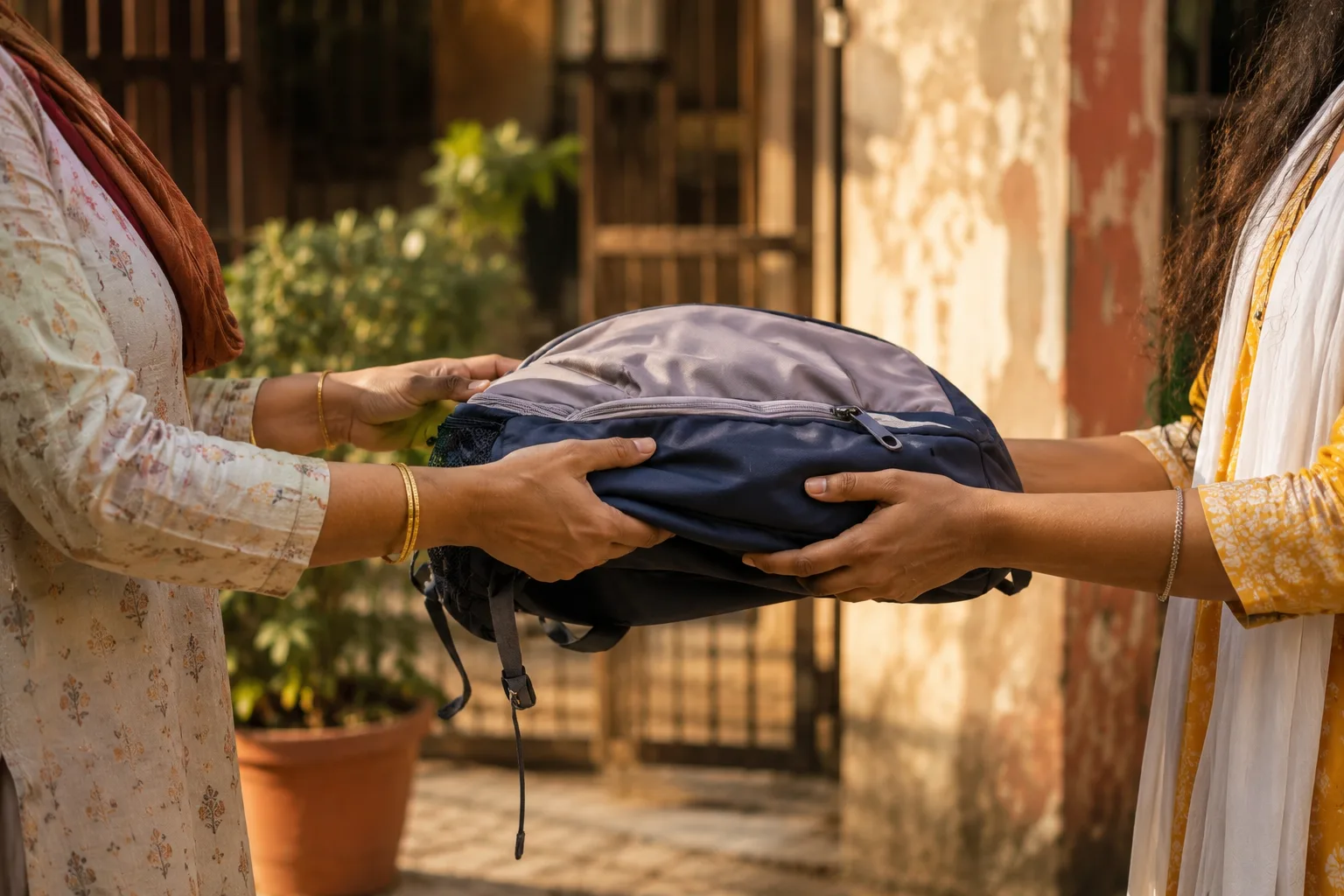
When you donate an in-kind item through CauseKind, the item you donate is the item received. There is no administrative layer between your donation and the person who needs it. The school bag you give is the school bag a child carries to class.
Zero overhead. 100% of what you give reaches the person it is intended for.
Benefit 2 - Speed: In-Kind Giving Moves in Days, Not Months
Cash CSR and formal monetary donation processes are slow.
From initial allocation to community impact, the typical cash-based giving cycle - NGO identification, due diligence, MOU signing, fund release, procurement, distribution - takes 3 to 18 months.
In-kind donation through a verified platform like CauseKind moves in a fundamentally different timeframe:
- Day 1: Recipient posts a verified request
- Day 2-5: Donor matches the request
- Day 3-7: Local handoff arranged and completed
- Day 7: Impact Certificate generated
A child who needs a school bag before term starts next Monday can receive it this week - not next quarter.
For time-sensitive needs - monsoon gear in June, exam stationery in January, warm clothing in November - speed is not a convenience. It is the difference between the donation mattering and arriving too late to matter.
Benefit 3 - Complete Transparency: You Know Exactly What Your Donation Provides
One of the most common frustrations among Indian donors is the inability to trace what their donation actually produced.
A cash donation to an NGO is pooled with other donations and spent across programmes. Your specific contribution cannot be traced to a specific outcome. The impact report you receive describes programme activities - 'workshops conducted,' 'beneficiaries reached' - not the specific result of your specific rupees.
In-kind donation is inherently transparent.
You give a specific item. That specific item reaches a specific verified person. You receive a specific Impact Certificate confirming delivery. You know - exactly, verifiably - what your donation produced.
This transparency is not just emotionally satisfying. It is increasingly important for corporate donors producing BRSR and ESG reports, and for individual donors who want confidence that their giving is genuinely impactful.
Benefit 4 - Hyperlocal Impact: Your Donation Stays in Your Community
CauseKind matches every in-kind donation within a 10 km radius of the donor.
This means your donation does not go to a national pool, a distant district, or a centralised warehouse. It goes to someone in your neighbourhood - the community you live in, work in, and move through every day.
The benefits of hyperlocal giving compound:
- No transport cost or carbon footprint from long-distance logistics
- The recipient is genuinely your neighbour - creating a direct community bond
- Local impact is visible - you may see the child wearing the uniform you donated
- Your generosity builds the social fabric of the specific place you inhabit
National giving is important for large-scale problems. Local in-kind giving is the most direct way to strengthen the community immediately around you.
Benefit 5 - Verified Impact Documentation for Corporates and Individuals
For corporate donors, in-kind giving through CauseKind produces ESG documentation that cash-based giving cannot match:
- Item-level donation records (what was given, quantity, condition)
- Verified recipient confirmation (independent, not self-reported)
- Delivery timestamp and location data
- Consolidated Impact Certificate suitable for Annual Report, BRSR filing, and CSR-2 reporting
For individual donors, the Impact Certificate provides:
- A permanent, shareable record of giving
- Specific evidence of community impact
- A feedback loop that sustains the habit of giving
Verified documentation is not bureaucracy. It is the foundation of trust between donors, recipients, and the platforms that connect them.
Benefit 6 - Dignity for the Recipient
There is a form of giving that communicates: 'I thought about what you need, and I chose this for you.'
And there is a form of giving that communicates: 'I have decided this is good enough to give away.'
In-kind donation, done well, is the first kind.
When a student receives a specific book they requested - the Class 9 science textbook they needed for the term that started three weeks ago - they receive something chosen for them. The specificity communicates consideration. The consideration communicates dignity.
When a family receives the exact size of tarpaulin they requested for a leaking roof section - not a general 'donation of goods' but the specific thing they asked for - they experience a form of being seen and responded to that cash donation, routed through an intermediary, cannot replicate.
In-kind giving, matched to a specific verified request, is one of the most dignity-preserving forms of charitable giving available.
Benefit 7 - Turning Existing Assets Into Community Good
Every household in urban India has goods that are no longer used - clothes that no longer fit, books that will not be re-read, devices that have been replaced, toys that have been outgrown.
These goods are not junk. They are assets - goods with remaining useful life that happen to be misallocated. They are in homes where they are no longer needed, rather than in the communities where they are urgently needed.
In-kind giving converts existing assets into community good without requiring any additional financial expenditure.
You do not need to spend money to donate a textbook. You need to find it on your shelf and match it to a student nearby.
This means in-kind giving is accessible to people across a much wider income range than cash giving. You do not need to be wealthy to give meaningfully in-kind. You need to have something that someone nearby needs - which, in urban India, is almost everyone.
Cash giving and in-kind giving are not competitors. They are complements - each more suited to certain types of need.
For the large, complex, infrastructure-level problems that India faces, cash is essential.
For the specific, immediate, community-level needs that determine whether a child attends school, whether a family stays dry during the monsoon, whether a student has what she needs to sit her board exams - in-kind giving is faster, more transparent, more dignified, and more efficient than any alternative.
Your items are assets. Your community has needs. CauseKind is the connection between the two.
Browse In-Kind Requests Near You → List Your Items on CauseKind → Read the Ultimate Guide to In-Kind Donations →
CauseKind is India's verified giving platform. Zero fees. Admin-verified listings. Every donation matched within 10 km and tracked to delivery.