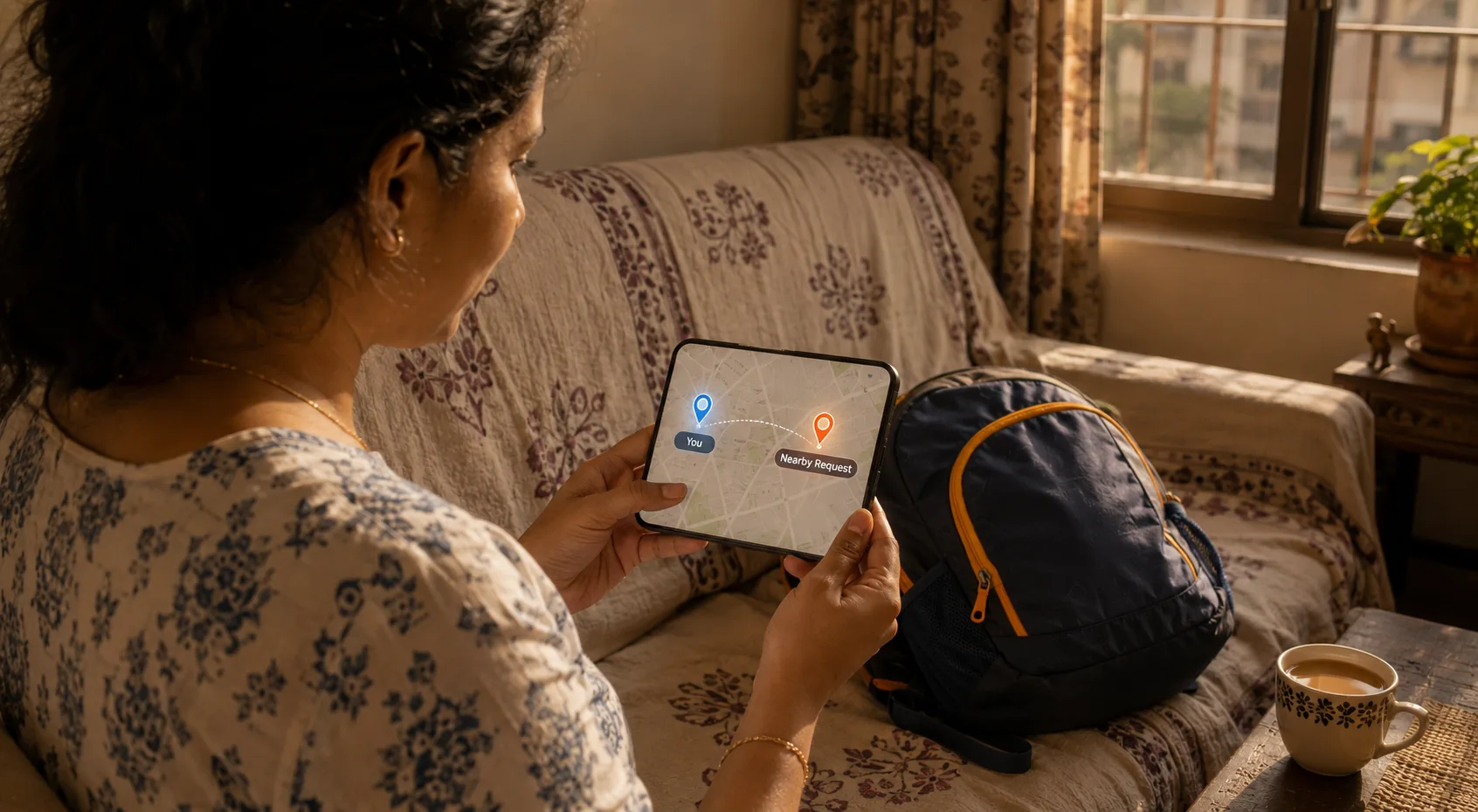
Most people who want to donate in India face the same invisible problem.
They have items to give. Nearby, in the same city, in the same neighbourhood, people need those exact items. But there is no simple, reliable, verified way to connect the two.
The donor searches online for an NGO. They find a few options. They are not sure which is legitimate. They are not sure if what they have to give matches what is needed. They do not know how to arrange delivery. They intend to figure it out 'this weekend' and never quite do.
Local donation matching is the solution to this specific problem. And the 10 km radius is why it works.
What Is Local Donation Matching?
Local donation matching is the process of connecting donors with verified recipients within a defined geographic radius - so that in-kind donations can be transferred directly, without shipping, without couriers, and without intermediary logistics.
On CauseKind, this radius is 10 km.
Every in-kind request posted on CauseKind is location-tagged. Every donor account is location-tagged. When you browse requests on CauseKind, you see only verified needs from within 10 km of your registered location.
When a match is made - donor offers an item that matches a recipient's request - both parties are within 10 km of each other. The handoff is arranged locally, directly, with no third-party logistics required.
Why 10 km? The Logic Behind Hyperlocal Giving
The 10 km radius was chosen for specific, evidence-based reasons:
It makes logistics zero-cost. Within 10 km of any urban location in India, a donor can reach the recipient by auto-rickshaw, two-wheeler, or on foot. No courier fee, no packaging cost, no delivery delay.
It ensures the donation is culturally relevant. A donor in a Marathi-speaking neighbourhood in Pune giving to a Marathi-speaking family in the same area gives items that are likely to be the right size, the right type, the right cultural context. Local knowledge is embedded in local giving.
It builds community bonds. When you donate within 10 km, you are giving to your neighbour - perhaps literally. The relationship between your locality's surplus and your locality's need becomes visible and personal.
It is environmentally efficient. Every kilometre of delivery distance adds carbon cost. Hyperlocal giving minimises the environmental footprint of charitable logistics.
It is scalable to India's density. India's urban density means that within 10 km of almost any urban location, there are thousands of potential donors and hundreds of potential recipients. The pool is large enough to ensure consistent matching without extending the radius.
How CauseKind's Matching Algorithm Works
When a recipient posts a verified in-kind request on CauseKind, the platform does the following:
- Geocodes the request - the recipient's location is mapped to a coordinate point (with privacy-preserving rounding to neighbourhood level, not street address)
- Makes the request discoverable to donors within 10 km - donors browsing the platform see requests within their radius, sorted by proximity and recency
- Sends notifications to registered donors in the area - donors who have listed available items or expressed interest in a category receive alerts when a matching request appears nearby
- Facilitates secure communication - once a donor accepts a match, both parties can communicate through the platform to arrange the handoff without sharing personal contact details until both parties consent
- Tracks the handoff and generates the Impact Certificate - once both parties confirm delivery, the matching cycle is complete and documented
The entire process - from request to delivery - typically takes 3 to 7 days for most items.
Privacy in Local Matching: How Recipient Addresses Are Protected
A common concern about local matching is privacy - specifically, whether posting a request reveals a recipient's home address to strangers.
CauseKind's matching system is designed with recipient privacy as a core requirement:
- Recipient location is displayed at neighbourhood or area level - not street address. A request appears as 'Andheri West, Mumbai' not '14 Lokhandwala Street, Andheri West.'
- Address is shared only after mutual consent - when both donor and recipient agree to a handoff, the specific meeting location is shared through the platform under mutual agreement. The recipient controls where the handoff happens - it can be at a neutral public location rather than their home.
- Recipient identity is verified but anonymised to donors - the donor knows the request is verified (by CauseKind's admin team) but does not see the recipient's name or ID until the recipient chooses to share it.
- All communication is on-platform until consent is given - phone numbers and personal details are never shared without explicit opt-in from both parties.
This privacy architecture protects recipients - many of whom are in vulnerable situations - while still enabling the specific, local matching that makes the system work.
What Happens When There Is No Match in 10 km?
The 10 km radius is the default. In cases where no match exists within 10 km - for rare or highly specific items, or for donors in areas with fewer recipients - CauseKind's system offers two options:
Extend the radius: Donors can opt to extend their matching radius to 25 km or 50 km. This requires the donor to arrange transport (typically a courier or auto delivery), but the platform facilitates the connection and the Impact Certificate system remains fully active.
Hold the listing: If the donor lists an item and no immediate request exists nearby, the listing remains active and recipients who post matching requests within the radius are notified. Most items find a match within 7 to 21 days.
Redirect to a partner NGO: For some categories - particularly large quantities of items - CauseKind can connect the donor with an NGO partner in their city that can receive and distribute the goods, even if no individual recipient request exists.
The Community Effect: What Happens When Local Matching Scales
Individual local matches are meaningful. But their cumulative effect - as a platform builds density of donors and recipients in a neighbourhood - is something qualitatively different.
When 50 donors in a 10 km radius are actively giving, and 100 verified recipients in the same radius are posting specific requests, the matching network becomes a community infrastructure.
Needs are met faster. Donors begin to understand the specific patterns of need in their area - what is needed before the school term, what is needed in monsoon season, what is consistently under-donated. Recipients develop confidence that specific needs can be met through the platform.
This is not just logistics. It is the social infrastructure of a community that has found a way to look after itself - neighbour to neighbour, item by item, 10 km at a time.
The gap between the person who has and the person who needs is almost always smaller than it appears.
In most Indian cities, it is 10 km or less.
CauseKind is the platform that closes it.
Browse Verified Requests in Your Area → List Your Items for Local Matching → Create Your Free CauseKind Account →
CauseKind is India's verified giving platform. Zero fees. Admin-verified listings. Every donation matched within 10 km and tracked to delivery.