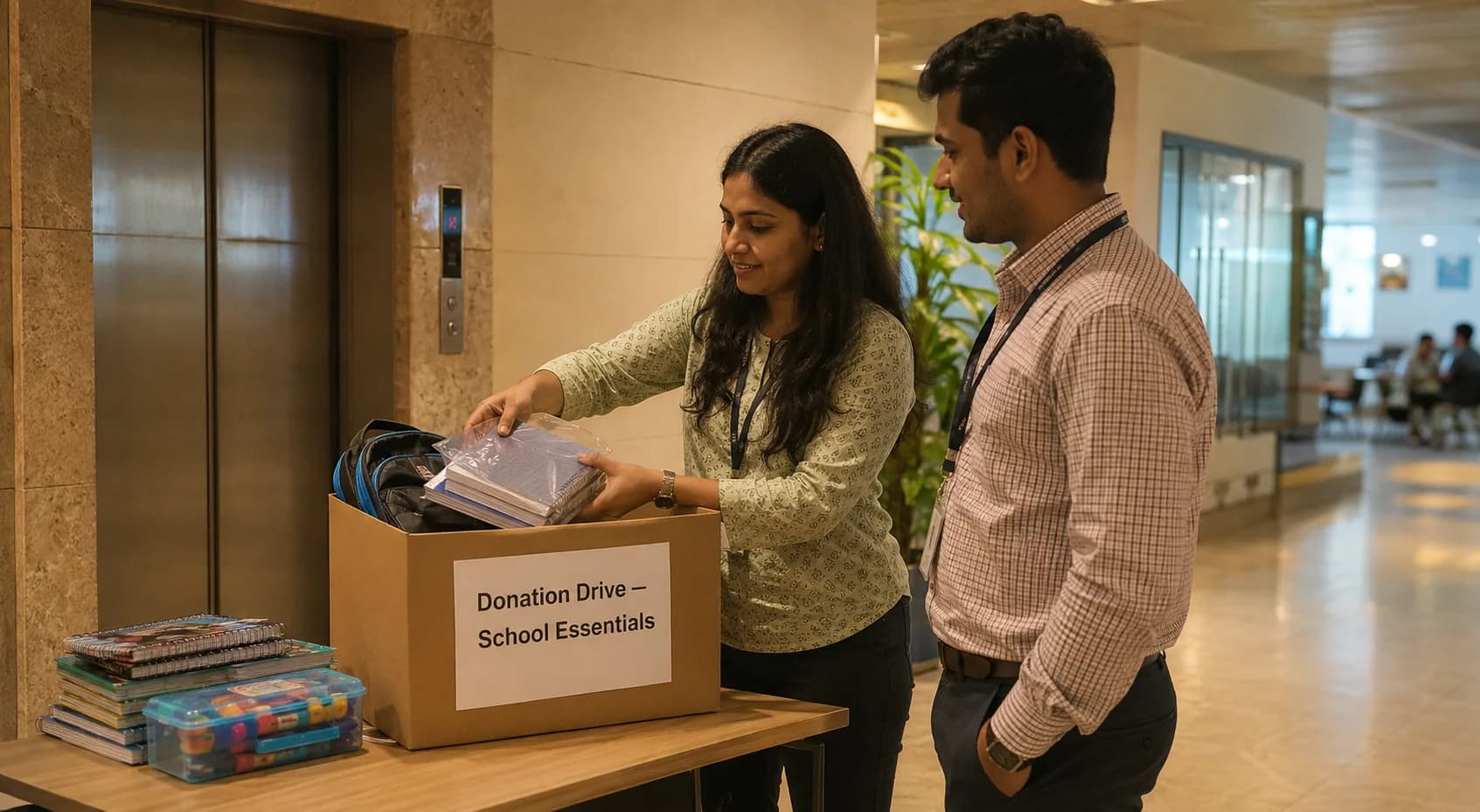
The idea is simple: bring people together, collect items that are needed, get them to the people who need them.
The execution is where most donation drives in India fall apart.
Items collected without knowing what is needed. No verified recipient identified before the drive. Collection boxes that sit unattended. Goods that pile up in a corner because nobody organised the delivery. Well-meaning efforts that produce boxes of unusable items that an NGO must now sort through and dispose of.
The difference between a donation drive that actually helps and one that creates extra work for everyone is almost entirely in the planning - specifically, in doing a handful of things in the right order before the collection box goes out.
This guide covers exactly that. Whether you are organising a drive for your office, your housing society, your school, or your neighbourhood - here is the complete process.
Step 1 - Identify the Recipient Before You Collect Anything
This is the most important and most consistently skipped step in Indian donation drive planning.
Most drives start with collection and end by searching for a recipient. This approach produces a mismatch between what is collected and what is needed - and places the burden of sorting and disposing of unusable items on the recipient organisation.
The correct sequence is:
- Identify the recipient and their specific needs
- Design your collection list around those specific needs
- Collect only what the recipient has confirmed they can use
How to find a verified recipient through CauseKind:
- Go to causekind.com/requests
- Browse verified in-kind requests in your area
- Filter by category (clothing, books, electronics, hygiene, etc.)
- Contact the organisation or individual through the platform to confirm they can receive the quantity you expect to collect
- Get written confirmation of what they need, in what quantities, by when
This one step eliminates the most common failure mode of donation drives.
Step 2 - Define Your Drive's Focus Clearly
Focused drives outperform general drives every time.
A drive that says 'bring anything you want to donate' produces a random assortment of items of varying quality and usefulness. A drive that says 'bring school bags, textbooks, and stationery for children in Class 6 to 10 at a government school in our area' produces a coherent, useful collection.
Choosing your focus:
- Match your timing to seasonal need: school supplies in April-May, monsoon gear in May-June, warm clothing in October, exam stationery in January
- Match your audience to the cause: a corporate office is well-placed to donate electronics and professional clothing; a housing society is well-placed to donate household items and children's goods
- Match your quantity ambition to your collection capacity: a 50-person office can realistically collect 50 to 150 items in a two-week drive; a 200-household society can collect 200 to 600 items
Write a one-sentence drive description:
'This drive collects school bags, textbooks (Class 6-10), and stationery for 40 students at [School Name] in [Area] before the new term starts on [Date].'
This sentence is your drive's identity. Use it in every communication.
Step 3 - Create a Specific Shopping and Donation List
Give participants exactly what they need to contribute effectively. A vague ask produces vague contributions. A specific list produces specific, useful items.
Sample Donation List Template:
'What to Bring - [Drive Name]
- ✅ What we need (new or good condition):
- School bags - sizes for children aged 8 to 14
- Textbooks - CBSE, Classes 6 to 10 (any subject)
- Notebooks - new or with significant unused pages
- Geometry boxes - new preferred
- Ballpoint pens - packs of 5 or 10
- ❌ Please do not bring:
- Torn or damaged items
- Textbooks more than 3 years old
- Notebooks with fewer than 20 blank pages'
Post this list at the collection point and share it digitally through every available channel.
If buying specifically to donate: Include price ranges so people know the approximate cost: 'A school bag costs ₹300-₹600. A pack of pens costs ₹30-₹60.' Removing price uncertainty increases participation significantly.
Step 4 - Set Up Your Collection Point
The collection point needs to be visible, accessible, and clearly labelled.
For offices:
- A clearly labelled cardboard box or dedicated table near the lift lobby, reception, or office kitchen
- A printed sign with the drive name, what to donate, and the end date
- A secondary collection point on each floor for large offices
For housing societies:
- Collection points at each tower entrance or near the main gate
- A notice on the society board and in the residents' WhatsApp group
- Assign a volunteer per tower who is the point of contact
For schools:
- A collection table near the school entrance or assembly area
- Brief announcement in morning assembly
- A note sent home with students
Collection point must-haves:
- Clear labelling: drive name, what is accepted, what is not
- A clean, dry, covered storage space - goods left in open spaces in corridors get damaged
- An end date prominently displayed - open-ended drives fade; drives with deadlines get last-minute contributions
- A volunteer or staff member responsible for monitoring it
Step 5 - Communicate the Drive Effectively
Three communication channels, used consistently across the two-week collection window:
Channel 1 - The Announcement (Day 0)
Email for offices. WhatsApp message for societies. Physical notice plus verbal announcement for schools. The announcement must include: what the drive is for, what to donate, where the collection point is, and the end date.
Channel 2 - The Reminder (Day 7)
A mid-drive update: how many items have been collected so far, what is still needed, and a reminder of the end date. Progress updates increase participation - people are more motivated when they can see the collection building.
Channel 3 - The Final Push (Day 12-13)
'Two days left - we still need [X items]. Here is the list.' A final, specific, urgent reminder consistently produces a significant percentage of total donations in the last 48 hours.
Language that works:
- Be specific about the recipient: 'These items go to 40 students at [School Name] before term starts on [Date]'
- Use numbers: 'We have collected 38 items so far - our target is 100'
- Make the action simple: 'Just bring one item to the box near the lift before Friday'
Step 6 - Sort and Quality Check Before Delivery
Before any collected items go to the recipient, a volunteer team should sort through them.
The sorting checklist:
- Remove any items that do not meet condition standards (torn, non-functional, wrong category)
- Count and record every item category and quantity
- Pack items neatly - clothes folded, stationery in sealed bags, books stacked by category
- Photograph the sorted, packed collection before delivery (for documentation)
Do not skip this step.
A recipient organisation that receives 80 bags of unsorted goods - including damaged items, wrong sizes, and random items not on the list - spends significant volunteer time managing the donation rather than distributing it.
A recipient that receives 80 bags of sorted, photographed, categorised items can distribute immediately.
Step 7 - Deliver Through CauseKind and Receive Your Impact Certificate
If you organised your drive through CauseKind's platform:
- Coordinate the delivery date and time with your recipient through the platform
- Confirm the handoff through the CauseKind app - both parties confirm receipt
- Your organisation receives a consolidated Impact Certificate covering the entire drive
This certificate includes:
- Total items donated and categories
- Recipient organisation name and verification status
- Delivery date and confirmation reference
- Platform verification code
For corporate drives, this serves as ESG and CSR documentation. For housing societies, it is a record of community service for the annual general meeting.
Step 8 - Close the Loop With Your Community
This is the step that turns a one-off drive into an annual tradition.
After the donation is delivered, share an update:
- Total items collected
- Who received them and where
- A photograph if the recipient consents
- A thank-you to everyone who contributed
In offices, a brief all-hands email or Slack message. In societies, a WhatsApp update. In schools, an assembly announcement.
The update serves two purposes: it gives participants the feedback loop that makes giving emotionally satisfying, and it sets the expectation that this drive will happen again - next quarter, next season, next year.
Drives that close the loop have significantly higher participation in their second and third iterations.
A well-organised donation drive is not a complicated thing. It is a few simple decisions made in the right order: know your recipient before you collect, collect specifically, communicate consistently, sort before delivery, and close the loop afterward.
The difference between a drive that helps and one that creates extra work is not enthusiasm. It is planning.
CauseKind handles the recipient matching, the verification, and the Impact Certificate - so your planning can focus entirely on your community.
Register Your Donation Drive on CauseKind → Find a Verified Recipient Near You → Download the Donation Drive Checklist → Read the Ultimate Guide to In-Kind Donations →
CauseKind is India's verified giving platform. Zero fees. Admin-verified listings. Every donation matched within 10 km and tracked to delivery.