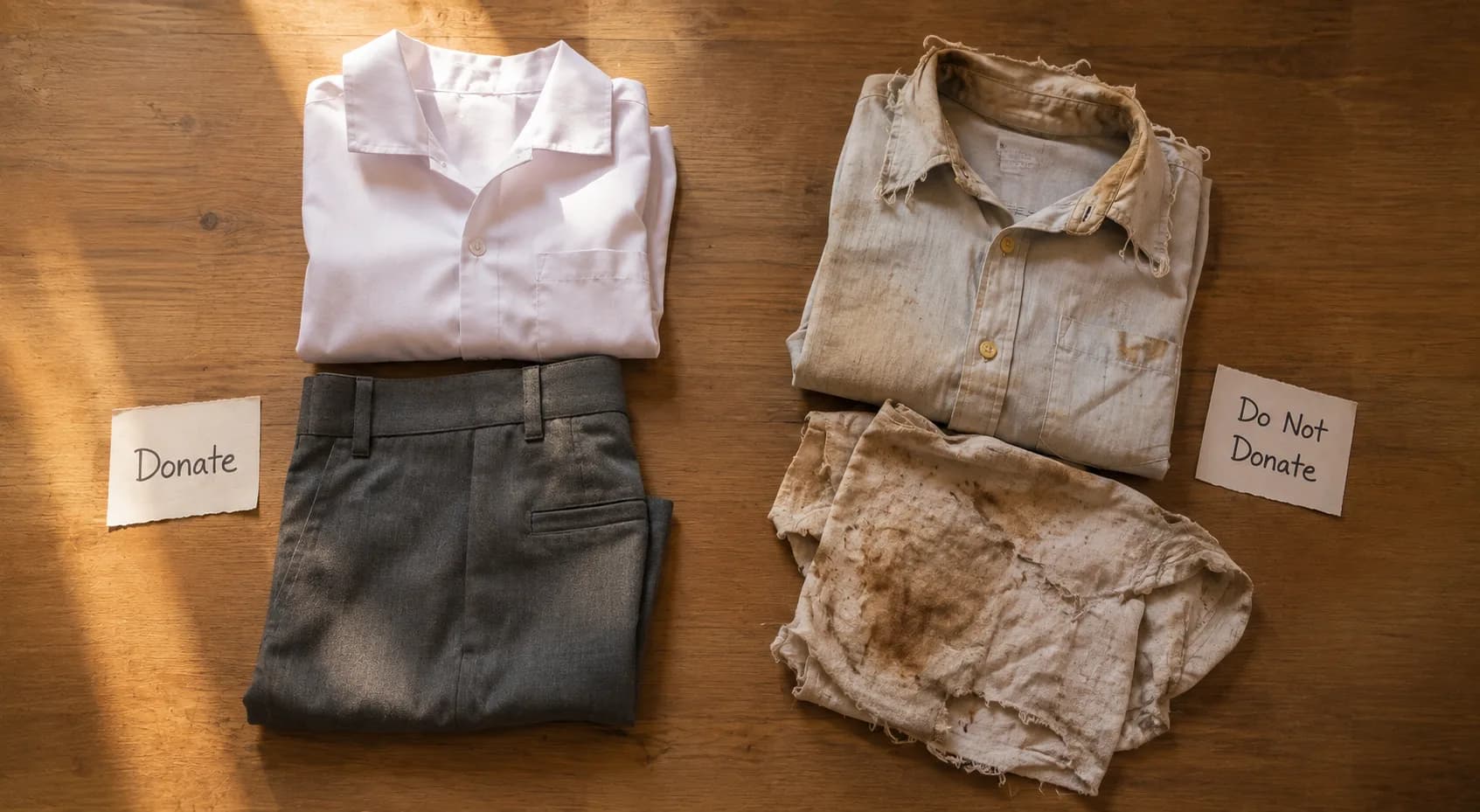
Let us start with something most donation guides are too polite to say directly:
Not everything you want to donate should be donated.
The impulse to give is good. But the impulse to give combined with the impulse to clear your wardrobe - without applying any standard to what goes into the donation bag - produces something that is not charity. It is clutter transfer.
And clutter transfer creates a real, specific, documented problem for the organisations and families on the receiving end: the time spent sorting through unusable items, the cost of disposing of them, the storage space consumed, the volunteers diverted from actual distribution work.
This guide names what should not be donated - directly, without softening the language - and explains why.
Never Donate: Used Undergarments
This is absolute. Non-negotiable. No exceptions.
Used undergarments - underwear, bras, undershirts worn against the body - should never be donated, regardless of:
- How clean they are
- How little they were worn
- How good the condition appears to be
This is a hygiene requirement and a dignity requirement simultaneously. The person receiving a donation of used undergarments is receiving an implicit message about what the donor thinks they deserve. That message is never acceptable.
What to do instead: Buy new undergarments to donate. A pack of new cotton underwear costs ₹80 to ₹200. It is among the most needed and least donated items in women's and children's shelters across India.
Do Not Donate: Damaged, Torn, or Irreparably Stained Clothing
If the item has:
- A collar that is visibly frayed or torn
- A tear in the fabric (not a loose seam - an actual tear in the cloth)
- Stains that washing does not remove
- Broken zippers or missing buttons that cannot easily be replaced
- Significant discolouration or bleaching
- it is not in donatable condition. It is damaged clothing that you have decided is charitable enough to give away rather than dispose of.
The cost of donating damaged items: An NGO volunteer must spend time sorting your damaged item out of the collection. It must be stored until disposal can be arranged. Disposal of fabric waste in India is not free or simple. You have effectively given the NGO a disposal problem and called it a donation.
What to do instead: Dispose of genuinely damaged clothing responsibly - many textile recycling initiatives (Goonj accepts fabric rags separately for conversion to other products) will take damaged cloth.
Do Not Donate: Unwashed or Damp Clothing
Clothing that has been stored unwashed, or that has become damp in storage, is not in donatable condition.
Damp clothing develops mould within days. Clothing stored unwashed carries odour that affects surrounding items. An organisation that receives a bag of damp clothes does not receive a donation - it receives a contamination risk for the rest of its collection.
Before donating: Wash everything. Dry it completely. Pack only when fully dry. If clothing has been in storage for more than a year, wash it again before packing.
Think Carefully Before Donating: Heavily Occasion-Specific or Out-of-Fashion Items
This category requires judgment rather than an absolute rule.
Heavily embroidered wedding lehengas, elaborate festival sherwani sets, extremely formal cocktail dresses - these items have limited practical utility for someone who is rebuilding their daily wardrobe. They cannot be worn to work, to school runs, or for everyday activities.
Before donating occasion wear, ask: Is there a specific community or organisation that would actually use this?
- A shelter home for women in crisis needs everyday wear, not wedding clothes
- However, a theatre group, a cultural organisation, or a programme specifically collecting occasion wear for specific events might genuinely want it
Context matters. Check what your specific recipient needs before including occasion wear in a donation.
Do Not Donate: Extremely Small Quantities of Mismatched Items
A single sock. Half a pair of gloves. One item from a set that cannot be used independently.
These items create sorting burden without creating value. Bundle them with matching items or dispose of them separately.
Do Not Donate: Items That Are Obviously Wrong for the Recipient
Know who you are donating to before you pack.
- Men's formal suits to a shelter home serving women and children
- Heavily Western formal wear to a community where it is culturally inappropriate for daily use
- Infant clothing to an organisation serving teenagers
- Thick winter coats to a shelter home in Chennai
Context-irrelevant donations are not helpful. They create sorting work and take space that should be occupied by items the recipient can actually use.
Solution: Browse CauseKind's verified requests before packing. You will see exactly what specific recipients in your area need - by category, size, and type. Donate to match.
The Two-Second Test Before Any Item Goes in the Bag
Hold the item up.
Ask: Would I give this to a colleague I respect, without embarrassment, as a gift?
If yes - it goes in the donation bag.
If no - it does not. It goes in the disposal pile.
This test is not about perfection. It is about whether the item communicates care or communicates disposal. The recipient will know the difference. The donation should communicate the former.
Frequently Asked Questions
Can I donate used underwear in India?
No. Used undergarments should never be donated. This is a hygiene and dignity requirement with no exceptions. Donate new, sealed undergarments instead.
Can I donate torn clothes to an NGO in India?
Clothes with significant tears should not be donated as wearable clothing. Some organisations like Goonj accept fabric rags separately for conversion to other products - but torn clothing should not go into a general clothing donation bag.
Should I wash clothes before donating?
Yes, absolutely. All donated clothing should be freshly washed and completely dry before packing. A recipient should be able to wear it the same day without washing it first.
The goal of clothing donation is to give something good - not to dispose of something unusable.
Applying a simple condition standard before packing your donation bag takes five minutes. It saves NGO volunteers hours of sorting time, protects the dignity of recipients, and ensures that your generosity actually produces what it is intended to produce: clean, wearable clothing in the hands of someone who needs it.
Donate what is good. Dispose of what is not. The difference matters enormously to the person on the other end.
Browse Verified Clothing Requests Near You → Read: How to Prepare Clothes for Donation → Create Your Free CauseKind Account →
CauseKind is India's verified giving platform. Zero fees. Admin-verified listings. Every donation matched within 10 km and tracked to delivery.